

Image generated by ChatGPT (OpenAI) using the DALL·E model.
Yes, it’s been a while since the last LifeBits post! I’ve been busy with a total redesign of a website that took much longer to complete than it should have (I am OCD about website functionality). I’ve also been obsessed with a new way of communicating via radio, which I’ll talk about in this post.
OK, I’m sure all of the hams (radio amateurs) on Facebook and Substack are going to protest at the title of this post, but it’s a reflection of my personality, not the millions of hams around the world.
My father, who had the US radio call sign NRØP (and WØIEQ before that) until his death in 2017, was a ham for many years. He started with radio before being drafted into the Army for service in Korea, and as a result he was trained and sent into battle as a radioman. That skill worked for him after the Army when he began working for United Air Lines (that was how the name was written in 1955 when he hired on) as an Instrumentation Technician, which basically means he worked on most of the electrical and electronic devices on an airplane — including the all-important radios.
One of my earliest memories was being in the basement of our house in Auburn, Washington where Dad had his ham shack (translation: his radios, maps, and collection of QSL cards — postcards sent between hams who had been in radio contact). This was in the early days of transistors, so much of the radio gear relied on vacuum tubes which would heat up and produce a unique burning smell. That’s what I remember the most; that smell, as well as the incessant beeping of Morse Code transmissions from around the world Dad was listening to.
When we moved from the Seattle area to Denver in 1963, Dad didn’t bring his ham gear with him. I’m not sure why; perhaps he realized that a new and more challenging career as a technician on flight simulators and raising two kids was going to limit his air time. To top it off, we lived in an apartment for two years, and I don’t think the landlord would have been too excited about Dad running wires between buildings for his antennas…
Dad got back into the hobby slowly, first getting a 2m/80cm VHF/UHF band mobile unit for his car in the 1980s. Then he ramped up his ham radio addiction when he retired and decided to get into the “old man’s hobby”. He had a number of powerful transceivers and a rather big antenna that is still at their former house because the new owners were too lazy to pull it down. Dad did a lot of chatting with a friend who was in the southern part of Colorado as well as being a regular on several local “nets” and doing a lot of DX (long-distance) contacts on high frequency bands.
At one point in the late 1990s, my nephew decided to get his ham radio technician license (the easiest to get) in order to snag a Boy Scout merit badge. My sister and her husband both decided to join him in getting their licenses, and I took that as a friendly sibling challenge… In 1999, I took the exam and got my call sign — KCØEZH. About that time I also bought a 2m/70cm Kenwood TM-V71A mobile radio for my car.
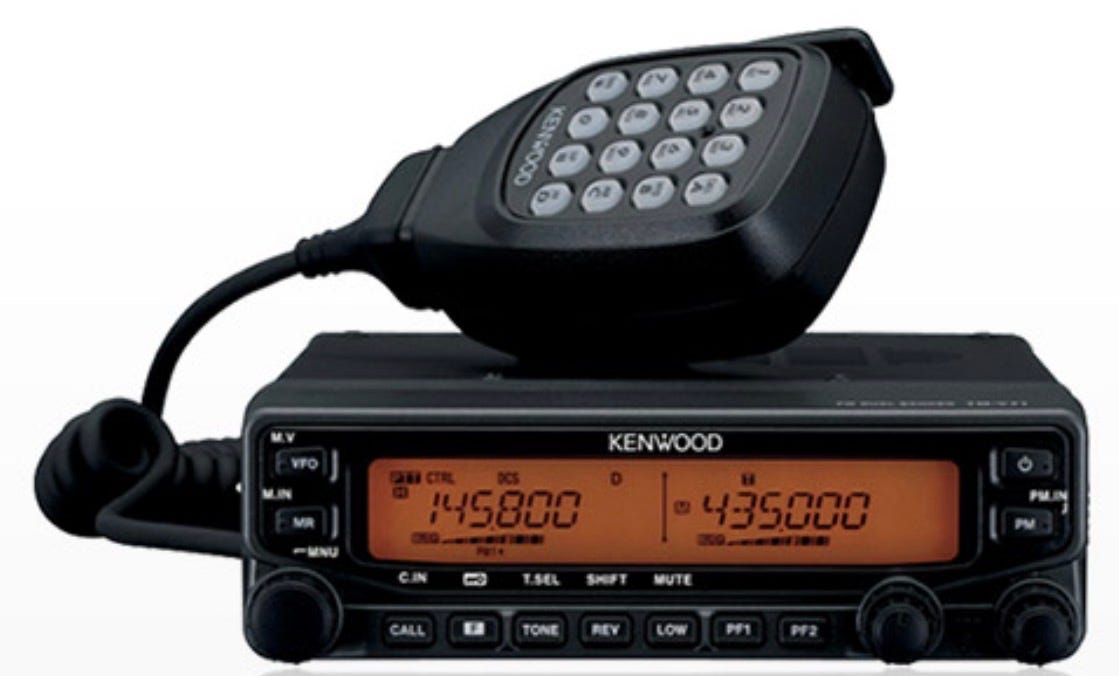
The Kenwood TM-V71A I had in my car when I discovered I hate talking on the radio to complete strangers.
That’s when I discovered that I really don’t like talking to total strangers on the radio… I’d set up the radio to broadcast through a local mountaintop repeater (takes your signal and rebroadcasts it to other transceivers, thereby increasing the range of your radio), and found the daily rag-chewing (that’s the term that is used for generally pointless conversations in ham radio) to be dull, often political, and boring.
In 2001 or 2002, I bought a Kenwood handheld transceiver with a built-in GPS so I could play with a digital-only radio mode called APRS (Automatic Packet Reporting System). You know how you can track the location of another iPhone user using “Find My”? Think of APRS as the pre-iPhone version of that feature.
It was kind of fun to have Dad track my position as I drove around town, but that “excitement” lasted for about a week. Probably the most fun I had with that radio was doing an APRS contact with the International Space Station during a pass that went over our neck of the woods. Somewhere I have a picture of the display showing that contact… but of course I couldn’t find it for this writeup.
I tried many times to get excited about ham radio again, but eventually sold all of my equipment. I did get a General License, which required another proctored exam that covered more technical subjects. I never felt that it was worth it to get the “top” license — the Extra — simply because I wasn’t using the privileges of the General License I already had…
LoRa
Well, radio kinda crept into my life again in 2025 when I heard about LoRa. From Wikipedia:
LoRa (from “long range”) is a physical proprietary radio communication technique based on spread spectrum modulation.[2] It is used as the physical layer for LoRaWAN, a low-power, wide-area network (LPWAN) protocol that wirelessly connects battery-operated devices to the Internet. LoRa can be thought of as the radio signal technology (similar to Wi-Fi or cellular), while LoRaWAN is the protocol and network architecture that manages communication over that signal.
LoRa communications right now are of two primary flavors. It’s like everything else in the IT world today — why have one protocol when you can have two or more competing protocols and get everyone fighting over which is superior? Those protocols are Meshtastic (which was the first) and MeshCore. Short and somewhat incorrect description: They allow long-distance encrypted texting over what is essentially long-range Wi-Fi.
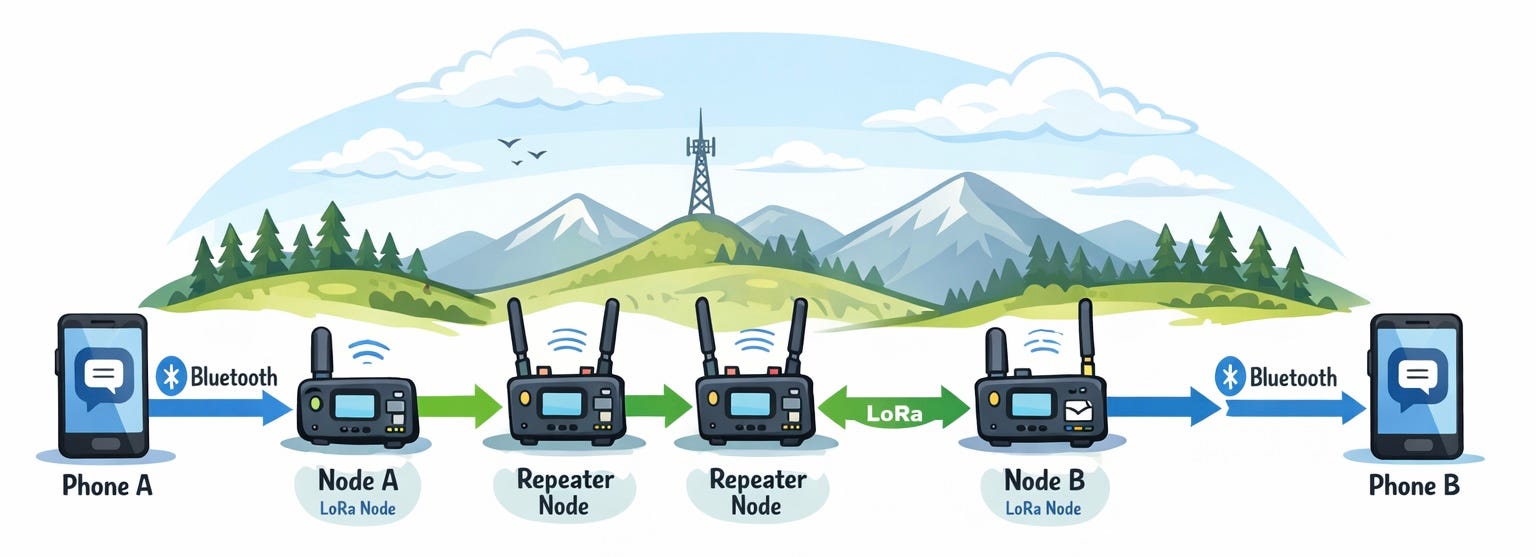
Diagram generated by ChatGPT (OpenAI) using the DALL·E model.
Originally, I think the little single-board microcontrollers that are used for LoRa were designed to be used for IoT (Internet of Things) applications. Say you were a farmer who wanted to turn on an irrigation pump a mile away. You’d put one node at your house, the other at the pump, and rig it up so when you signaled the pump it would start or stop running depending on its current state. Dedicated nerds have turned this into a public low-cost mesh network for sending short messages back and forth.
LoRa doesn’t require an FCC license, it’s all digital, and is touted (like most amateur radio fans like to brag) as the perfect tool in catastrophes. When the SHTF (“💩 hits the fan”) and the power is out, allegedly only hams will be able to communicate via battery powered devices - when they’re not fighting the zombie apocalypse, that is. That’s been true in floods, hurricanes, and other natural disasters, and I’m not making light of the enormous contribution hams have made to disaster recovery efforts. However, I wonder how many hams (and non-licensed LoRa fans) have backup radio equipment stored in EMP-proof Faraday cages for the true doomsday scenario?
There’s another issue with the SHTF scenario; most Meshtastic and MeshCore boards require a Bluetooth connection to a smartphone app (iOS or Android) in order to communicate. The phone connects to the radio, which sends out the message to the mesh network, and someone receives it with their radio and reads it on their phone (see diagram above few paragraphs ago). What happens if that EMP takes out your phone? That’s why there are some all-in-one devices that have their own keyboards.
I started playing with LoRa after seeing a YouTube video in which a guy connected a Meshtastic radio board to a PicoCalc, which gave him a LoRa-connected “cyberdeck”. Sure, these things can’t do everything that a smartphone can, but they’re almost like a hobbyist’s smartphone…
I actually had a PicoCalc on order… but then I realized that they are rather limited, which is why I decided to buy a Raspberry Pi 500 instead. I waited two months for the damned thing to ship, and canceled it when it was getting ready to wing its way to me.
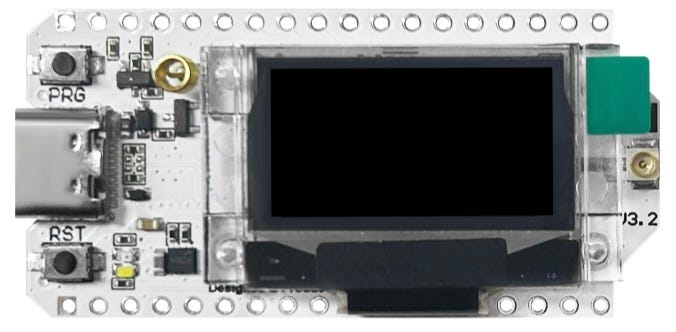
Heltec V3. That’s a USB-C port on the left side, and a tiny LCD display covers much of the board. The little thing that looks like a gold spring at the upper left of the display is the Bluetooth antenna.
Anyway, my first move was to try Meshtastic using a Heltec V3 single-board computer. I added a cheap antenna, and I think my whole investment was about $40. This is where another of my reasons for not liking radio of any kind reared its ugly head again…
I live in a radio frequency (RF) “black hole”. I’ve always had issues with cell phone signals — even now I have to use Wi-Fi Calling at my house. Back in the analog cell phone days I never got a signal until I was well out of my neighborhood. On top of that radio shadow looms the fact that I live in a community with restrictive covenants banning any visible antennas (except for Dish Network dishes… go figure), so I’m basically screwed when it comes to receiving or sending most RF emissions.
My experiment with Meshtastic was pretty much a bust. I could receive occasional messages, but never had any outgoing texts received. About the end of January, I found out that there were some people in the Denver area who were starting to play with the other protocol — MeshCore. It’s possible to re-program these single-board computer / radios between protocols by re-flashing their firmware, so I did that.
At the beginning of February, I was seeing MeshCore contacts from a handful of people in the Colorado Front Range. Now the number is well over a hundred, so things are looking up. I still couldn’t reliably transmit to other nodes on the network, so I decided to make another investment in a RAK WisMesh 1W Booster. That 1W is the maximum transmit power in Watts; the Heltec maxed out at about .2W. More power, more distance, right?
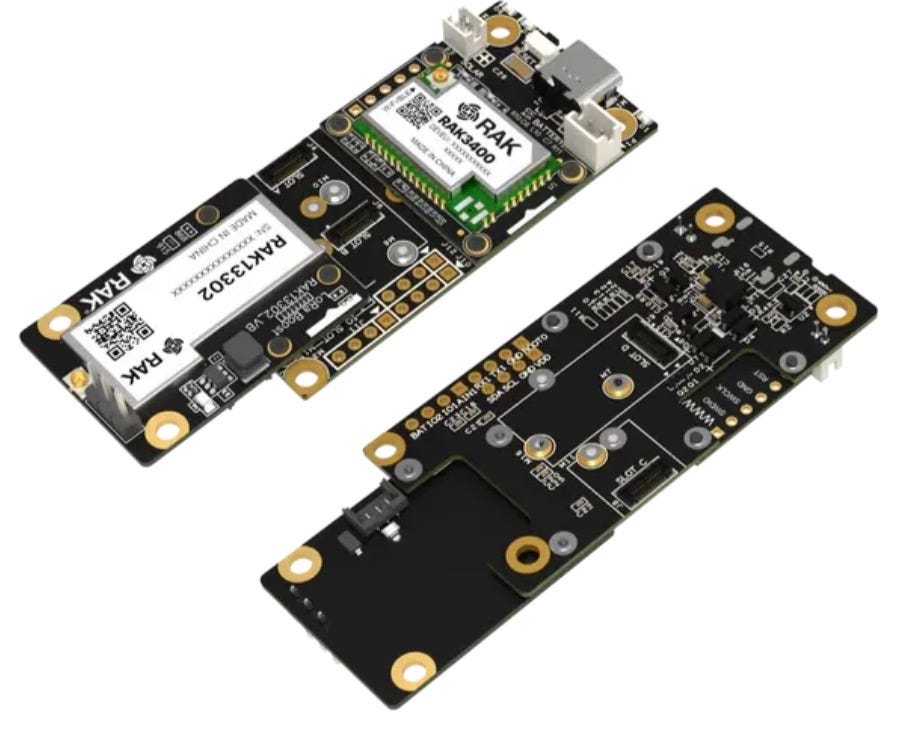
The RAK WisMesh 1W Booster “Starter Kit” that I thought would connect me to the mesh…
Not necessarily.
On March 9, 2026 I flashed the RAK with MeshCore firmware, attached a rather big antenna, powered it up, and excitedly mounted it in my west-facing upstairs window. About 30 minutes later I started receiving some messages, although it did not appear that anyone was “hearing” my repeated “adverts”. No problem… a lot of the repeaters that re-transmit messages around the area only advertise themselves every six hours or so, and I didn’t expect to see them for a while.
A few hours later, it occurred to me that I was no further along with the RAK than I was with the Heltec. In fact, So, what’s my solution other than selling this stuff on eBay and vowing to never play with it again? I’m gonna sell the stuff on eBay and replace it with something I can carry with me. At least I’ll be able to send messages when I’m away from home and out of the RF pit.
I’ve had numerous folks on the local net tell me to just install the darned nodes as high as I can on my house (preferably on a mast of some sort that sticks up even higher), but I have a) the restrictive covenants and b) a fear of falling off the roof and breaking my 68-year-old body.
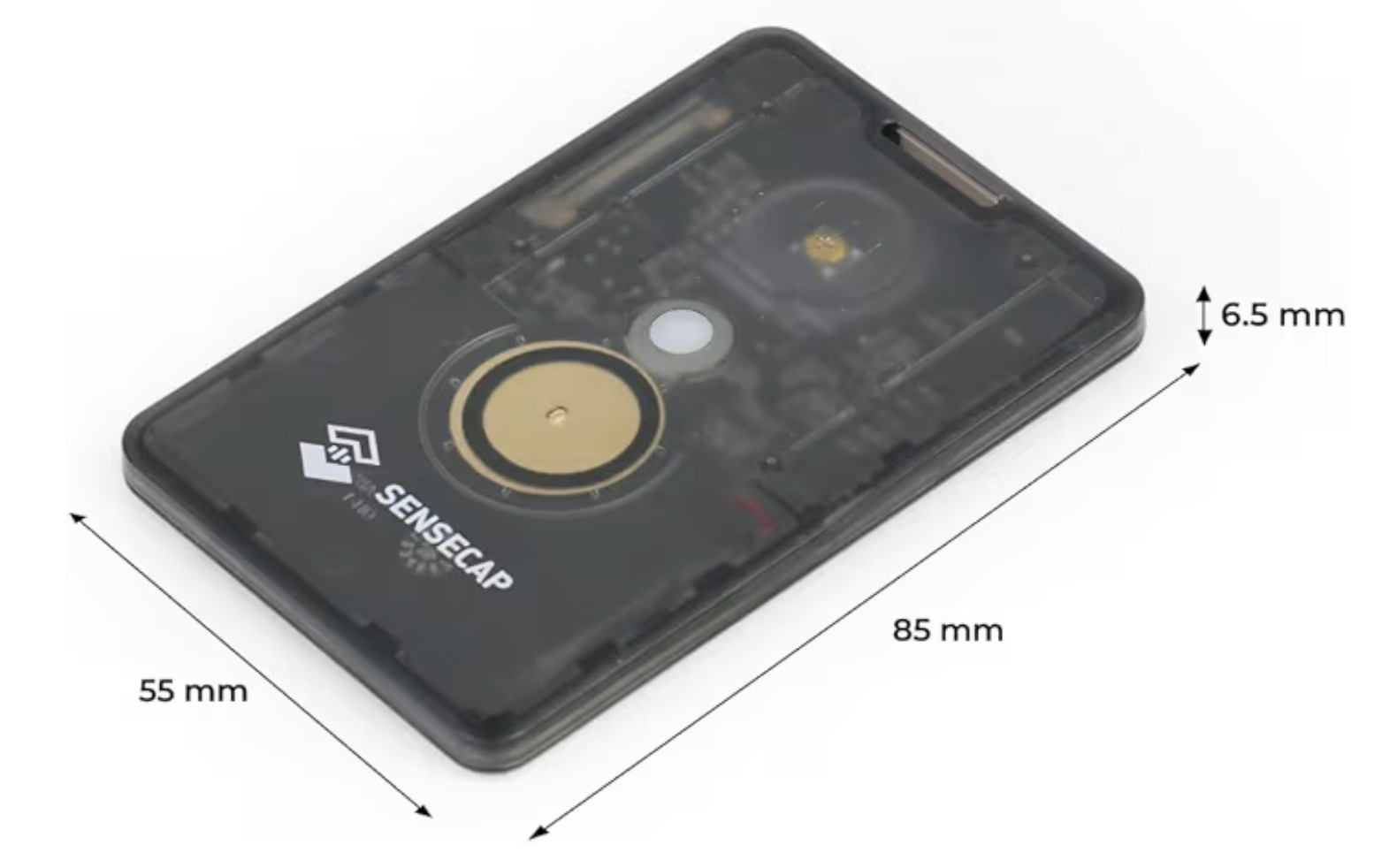
The Seeed SenseCap T-1000E. For those who are metric-phobic, those measurements are 3.3 x 2.2 x .26 inches.
There’s a good cheap credit-card sized node called the Seeed SenseCAP Card Tracker T-1000E that can be flashed for either Meshtastic or MeshCore. It lasts for a few days on a single charge, has limited range (so I’ll probably only send/receive messages when I’m within a couple of miles of a repeater), and it actually has some features that the other nodes didn’t — GPS and a temperature sensor, although I’m not sure the MeshCore application can actually take advantage of the temperature.
This gives this retired guy something to play with, and I don’t have to actually talk to people. I can just send ‘em 131-character (max) messages and then move on. It’s perfect for an antisocial radio amateur! With apologies to some of the folks in the local MeshCore community, here’s an example of the sparkling conversations I’m seeing right now:
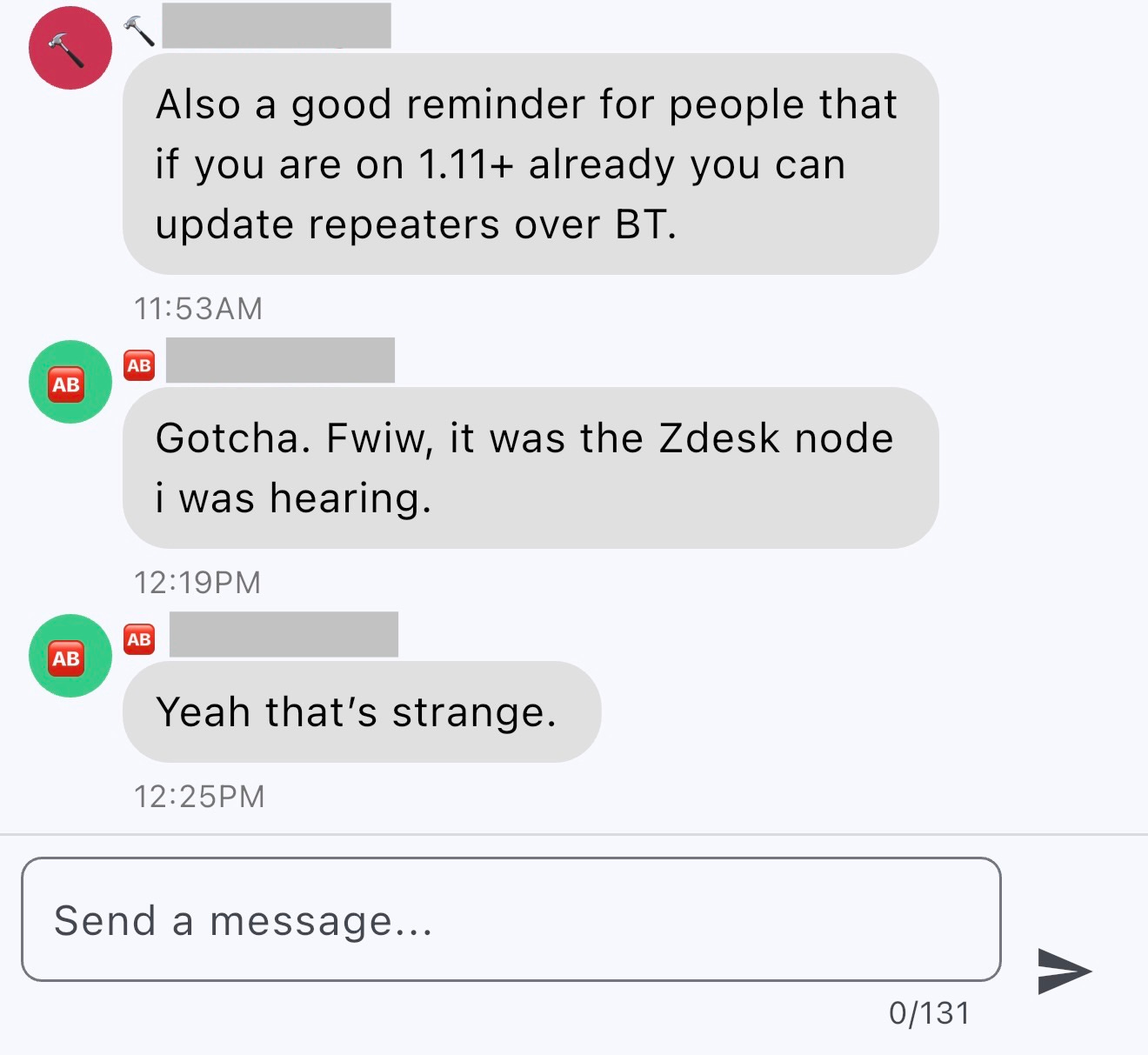
Now those are conversations I can get excited about! 🤪
Did you have fun reading this? If you didn’t, did you at least learn something you didn’t know before you read the article? Both of these are what I’m attempting to accomplish with LifeBits. Be sure to “Like” this post, subscribe to LifeBits for FREE to get this in your email inbox, and even better, be sure to share this post with friends using that button below.
Until next time… dream up ways for me to place a solar-powered MeshCore repeater on my rooftop without having to climb on a ladder.