

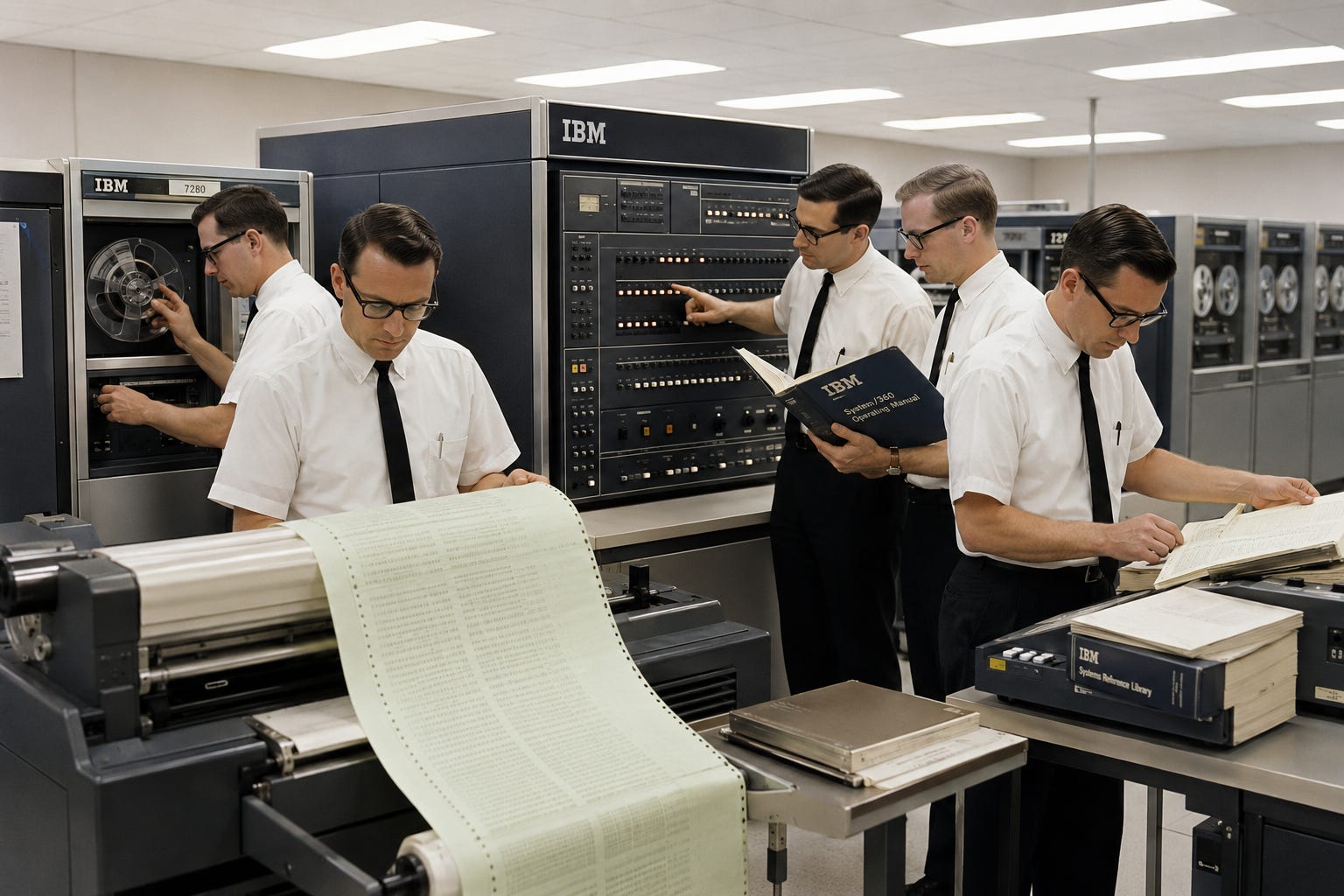
Nerd alert! What we commonly thought of when we heard the word “computer” in the 1970s. Image generated by ChatGPT (OpenAI) using the DALL·E model.
I didn’t set out to be a computer nerd.
Although I had enjoyed working with computers in junior high and high school in the late 1960s and early 1970s, I really didn’t want to work with them all the time. It seemed like those who worked with computers wore thick glasses, had no personality, wore white shirts with skinny black ties, and stood around leafing through thick piles of printouts with grim looks on their faces. In other words, they looked like the unsmiling group in the picture I had ChatGPT cook up for the top of this post.
Our school counselors depended on a test to try to tell us what careers we should go into rather than just let us wander aimlessly into something we liked. They used a tool (still around) called the Kuder Vocational Preference Test. It was administered by poking out chads on punch card sheets with your answer for each question, after which the hole-covered sheets were processed and a response with suggested career paths was created.
A quite sarcastic (and popular) teacher at our junior high school referred to it as the “punch ‘n giggle test,” which was an apt assessment of the test as the students being tested were punching holes in paper and usually laughing at some of the questions. I remember them as being along the line of “Do you prefer sweeping a floor or playing the trombone?” “Which of the following three things excites you the most: A) Sanding a block of wood, B) Changing the ribbon on a typewriter, C) Removing earwax from your ears?”
A classmate was really quite upset when the results of the test found that he had both musical and mathematical skills, which destined him to a career as a piano tuner. It’s really too bad I didn’t keep in touch with him, as our piano needs to be tuned…
My results pointed me in the direction of engineering or science, which I was happy with although I was already behind the eight ball in preparing for this career because I honestly wasn’t that good in math. Oh, well — I still had four years in which to try to catch up.
Fortunately for me, I got excited by the early 1970s trend toward “high tech” transportation systems, especially PRT — Personal Rapid Transit. These systems were going to revolutionize cities, and we’d all live near stations where we’d sit down in a small pod, tap in a code, and be whisked off quickly to whatever destination we had chosen. Spoiler alert: These never happened. Well, maybe in some alternate universe, but not in ours.
I wrote letters to companies spearheading development of these systems while I was a sophomore in high school, and got answers from a few of them, all encouraging me to get into engineering. Although I was a space and model rocket geek, my dad didn’t want me to follow my dream of working on the space program as an aerospace engineer, because aerospace companies had a history of laying off staff when some pet project lost funding. The easiest path to an engineering degree seemed to be civil engineering, so that’s what I decided to do.
Little did I know at the time that civil engineering covers a lot of ground — structural engineering, fluid dynamics, environmental engineering and water treatment, geotechnical engineering, and more. Rather than specialize in any one area while I was in civil engineering school at the University of Colorado Boulder, I decided to just be a generalist. I did pretty well; graduated with a 3.73 out of 4.0 GPA!
Upon graduation, I had a number of job offers — times were good for engineering grads. I was getting pretty serious about my relationship with my girlfriend (now wife of 47 years), so I wanted to stay in the Denver area. The best offer I got was from Public Service Company of Colorado (AKA PSCo), a gas and electric utility company. I would work for the natural gas side of the company, and my “fluids” background would get a workout.
Well, fast forward a few years in my career and I had gotten bored doing computer studies of the gas distribution system of Denver in a gas system planning department. I also had a boss who was — to put it nicely — crazy, so I moved to a PSCo subsidiary called Western Slope Gas Company. Despite the name, the company actually had high pressure gas transmission lines all over the state of Colorado, resulting in an eventual name change to WestGas.
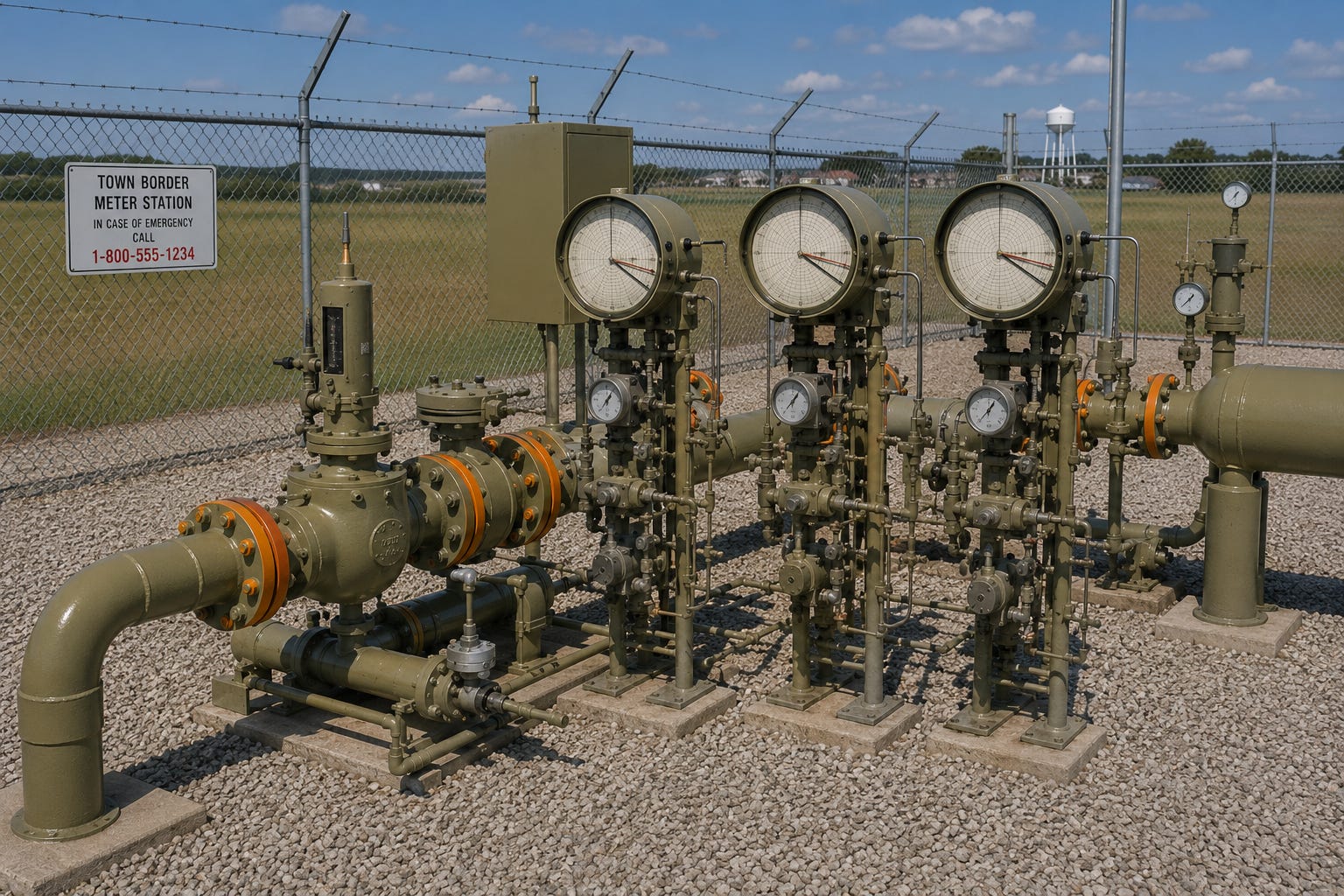
A pretty decent ChatGPT representation of what one of our metering stations looked like.
I started as the “metering and sales engineer,” which means that I designed gas metering and regulation facilities. The job was interesting… for a while. I quickly mastered the design process, wrote some calculator programs (TI-59, HP-41) to speed up my calculations, and just like that the job became a lot of boring cookbook engineering and arguing with the draftsmen who drew up blueprints of my designs (they hated engineers).
A department of the company called “Special Projects” intrigued me, because they were assigned engineering tasks that were out of the ordinary. Did someone need to figure out how a new federal pipeline regulation would affect the company? Why was a specific part of a gas gathering system leaking while the rest of the system was fine? How could we create some set criteria for vetting contractors that worked on building our facilities? All of these problems, and more, were assigned to Special Projects.
Eventually, I swapped jobs with another engineer and got into that department. My boss at the time was unique in that he had his own computer on his desk — a Radio Shack TRS-80 Model III. It was his personal machine; our company wouldn’t purchase computers for office use. He did his best to try to show other managers in the company the utility of desktop computers, planning and tracking his department budget in a spreadsheet, writing reports, and even doing some cursory application development in BASIC.
The Computer Study
In the late summer of 1984, the head of our company asked us to do a “computer study”. He was getting tired of getting budget requests for personal computers, and all of them were different: some wanted Apple IIs, some lusted after TRS-80s, and others desired the just-released IBM PC. Since I had a computer at home (at this time a Sanyo MBC-555 DOS machine), I was tasked with the study.
I had just finished my graduate work for an MBA, so I thought the best way of “selling” the big boss on personal computers would be to appeal to his financial senses. In other words, doing a cost/benefit study that would determine how long it would take for these machines to pay for their cost in accrued productivity gains.
How did I estimate productivity gains? I asked the managers at our facilities around the state what functions were performed, how long it took for them to do those tasks, and how many times a year they were done. For example, budgeting (both budget estimates and tracking actual progress against estimate), HR tasks (keeping track of employees and their performance), various record-keeping processes (like inventories of spare capital equipment or office supplies), project management and so on.
I knew how long it would take to do those same tasks using a computer since I set up each example on my home computer. In almost every situation, the computer shaved time off of the processes and those were our productivity gains. Remember, at this time there was no Internet, no way to order equipment, hire contractors, or do any one of ten thousand other things online! We were strictly basing the productivity gains on time savings and average employee wages.
In our main office, there were a number of secretaries (remember those?) whose sole task was to type up letters and reports, do filing, and so on. For them, the productivity gains would come from word processing rather than typing; getting a document “right” before printing, being able to save and re-use common letters and forms, and so on. For those managers in the field offices, hunt and peck typing was the norm so the time savings reusing templates for common documents would be just as large.
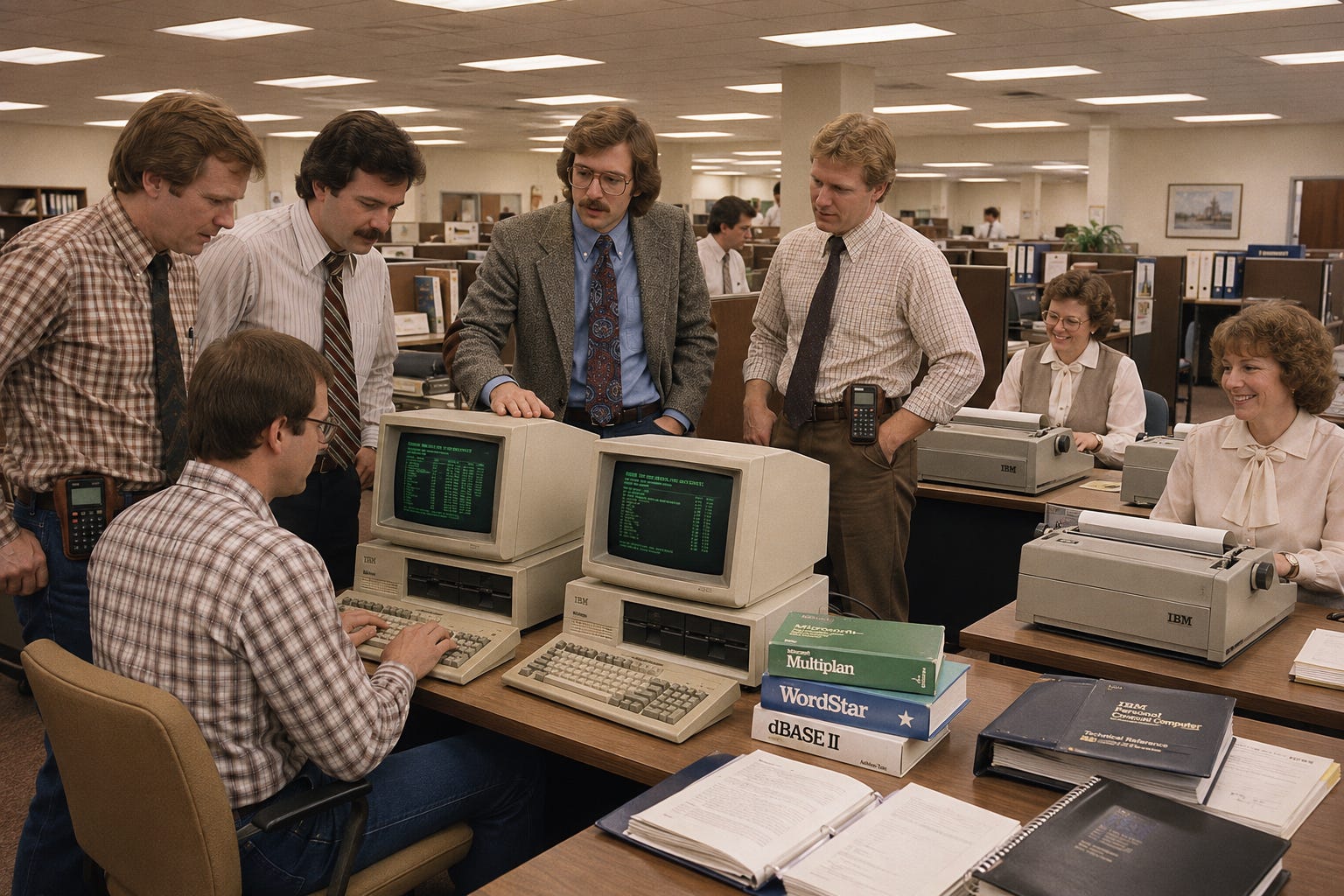
A disturbingly accurate depiction of what our office looked like in 1984. Image generated by ChatGPT (OpenAI) using the DALL·E model.
The Bottom Line
This was 1984 and I was trying to do my best to convince an old-school executive to let us buy a handful of computers. My recommendation (which was quickly approved) was to buy four IBM PCs and two IBM Displaywriters. There was a common IT mantra back in the day: “Nobody ever got fired for recommending IBM”. That wasn’t the only reason; we didn’t trust the few PC clone manufacturers that were around at the time.
Fortunately for you, dear reader, a search through my file cabinet did not turn up a copy of the study. You have been spared the boredom of seeing a bunch of time and cost estimates and the ROI calculations that showed we’d be able to pay back our investment in just a few years. The VP decided that since we now had a “plan”, implementation and future purchases would be left up to approval by the various division managers.
Although we bought the PCs and Displaywriters that were recommended… things went off the rails pretty quickly. By late 1984, many of the engineers and a few managers had their own computers at home and the clamor for more computers at work grew louder. Having to share two PCs between our finance and accounting people, a number of engineers and technicians in our main office, some smart folks in our “chart processing” and billing department (they took circular paper charts, integrated them to determine gas usage, and then worked up billing statements for customers), and a few managers started to get out of hand. The other two PCs had been assigned to our largest field offices, so we had about 150 people fighting over a pair of floppy disk-based IBM PCs. That wasn’t going to work out in the long run…
I won’t spoil the fun for a future LifeBits article, but let’s just say that we didn’t order too many PCs in the future because of one guy who brought his Mac to work…