

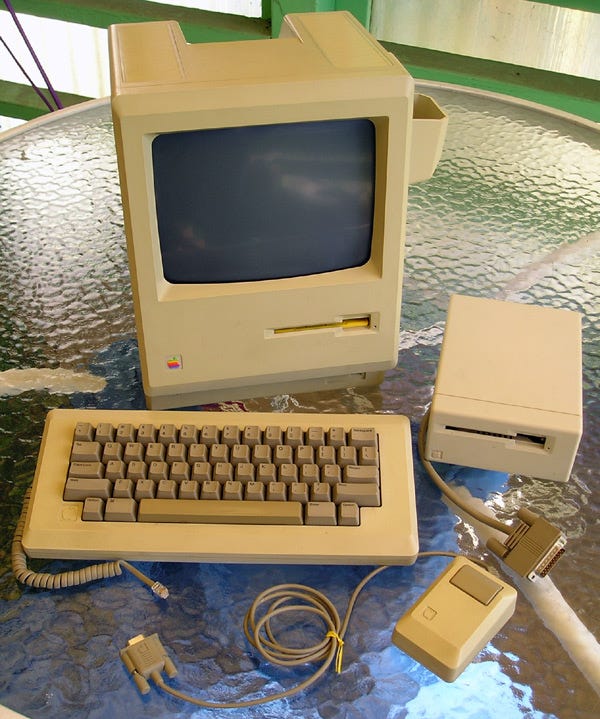
Photo by Ellen Levy Finch (Elf | Talk) March 24 2004. This file is licensed under the Creative CommonsAttribution-Share Alike 3.0 Unported license. In case you’re wondering, that blob on the right side of this Mac 512K is a third-party “mouse holder”.
I wrote most of this article a while back, got busy traveling, became involved with trying to adopt a pair of cats, and before you know it, the post had vanished into thin air. Apparently it’s still on my iCloud Drive in some sort of ghost state, but nothing can open it.
What started this all off was the need to finally write about the computer that shaped my life for the last 42 years — the Apple Macintosh. Just to give you an idea of how long that has been, I’ve “only” been married for 47 years and lived in my current house for that same 42 years. In that time I’ve gone through a bunch of changes in my life and careers, but the constants since the end of 1984 have been the Mac and Apple.
If you’ve read my previous posts about my fun with the Commodore 64 and the odd but shiny Sanyo MBC-555, or about the overly-detailed personal computer study I did for my employer, you’ll know that I was quickly turning from a career in civil engineering to a lifelong tech career. In the cold winter days of January, 1984, the news was all abuzz about the Apple Macintosh, a small 128K computer that would be the first mass-market personal computer to boast a graphical user interface (GUI) using windows on a bit-mapped display and a mouse. It sounded pretty cool, so my boss and I grabbed a pool car and drove to a computer store on the south side of Denver on Tuesday, January 24, 1984 to see one in person.
By the time we arrived at the store in mid-morning, we would be seeing “one” Mac — the display model — because they had already sold out of the $2,495 (equivalent to $8,044 today!) stock they had received for the introduction. Of course, there was a line of people who wanted to try it out. We stood in line for a while, and finally got up to the machine where they were running a demo that consisted of showing you how to use this newfangled user interface (that same demo shipped with all of the early Macs, by the way).
We both went through that demo, and then I had to be a jerk and hold up the line by asking to try out MacWrite. The store employee obliged, so I typed out some nonsense and then changed the font and text size — something that was really quite difficult to do on most other computers and impossible to see on the screen of virtually every PC except for the Mac and Apple Lisa. I sent that sheet to an Imagewriter printer that was sitting nearby, and everyone — including myself — oohed and ahhed as it buzzed out my printout.
As my boss Kerry and I drove back to the office, we both agreed that the Mac was the future of computing, but like the $9,995 ($32,224 in 2026 dollars) Apple Lisa, it was still too damned expensive for what you got. We had also talked about bit with the sales rep about some of the complaints he was hearing about the Mac. Most of that had to do with not being able to run some programs that were in development because of the limited RAM and 400K disk size.
It wasn’t as if RAM was something magical at that point in time — Commodore delivered the Commodore 128 (128K RAM, yet compatible with the Commodore 64) in early 1985 for just $299, and expansion cards for the IBM PC and similar computers were commonly offering 640K of RAM.
So I kept myself occupied with my execrable Sanyo MBC-555 at home and the IBM PCs at work, and dreamed of a more powerful and affordable Mac. That dream became closer to reality when Apple announced the $3,195 (about $10,300 in 2026 dollars) 512K Mac. That price tag was still seemingly out of my grasp, but the technical limitations were beginning to disappear.
Quadrupling the RAM on the “Fat Mac” to 512K enabled the release of some groundbreaking programs. MacProject had not run well on the 128K Mac according to our buddy at the computer store, but we heard that it was rather awe-inspiring on the 512K. Management was getting interested in having a way to manage our many pipeline construction projects, so waving a printout from the store Mac 512K showing a graphical layout of a project schedule and the critical path in front of them was like offering catnip to a cat. They were very interested… but still didn’t want to spend company funds on an Apple product.
Fast forward to December of 1984. Sales of the Mac had stagnated somewhat after a robust start, mainly due to the price, the lack of software, and that limited RAM. So what did Apple CEO John Sculley (former Pepsi boss) do? He came up with the “Test Drive A Mac” promotion. To kick off this amazing promo, the company bought all 39 pages of advertising in the November 8, 1984 issue of Newsweek magazine to tout the Mac and this rather crazy idea.
Anyone could walk into a store selling Apple computers (there were no Apple stores at the time, of course) with a credit card or apply for an “Apple Card” (not like today’s Apple Card - you could only purchase Apple products with this one), take home a Mac for 24 hours, and if they liked it, they could keep it. I decided to give it a try. There was a Nynex Business Center in downtown Denver selling Macs, so I wandered in there after work on December 21, 1984. Now, Christmas this year was on a Tuesday, so most businesses were shutting down on Friday the 21st and would not reopen until Wednesday morning, the 26th. My hope was that I’d have five full days to “test drive a Mac”, and my hope was fulfilled.
I filled out the credit application, the staff plopped a 128K Mac into a nice beige Apple-logo’d carrying bag, and I headed out the door with a big grin on my face. The idea was that I wasn’t going to keep the 128K, but this was my way to show my wife this expensive piece of technology and get her buy-in on me purchasing one. I had really thought this through — I was also going to put it on that Apple Credit Card and actually be able to build up a credit rating by faithfully paying off the purchase over two or three years!
The five days and nights went by quickly. I tried all of the demo software, had a blast with MacWrite and MacPaint, and let my wife, my mom & dad, my in-laws, and even an aunt who was visiting from out of town try their hand at mouse-powered computing. Everyone was amazed. My dad, who had worked with computers for years in his job as a flight simulation engineer for United Airlines, was completely impressed with the clarity of the tiny monochrome screen and how easy it was to use.
Well, Wednesday morning arrived and my first business of the day was to skip out of work and take the Mac back to the store. I knew that I was going to buy a Mac, but it wasn’t going to be a slightly-used 128K. I just needed to wait for the price of a Mac 512K to drop a bit and then I’d make my move.
That happened on Valentine’s Day, February 14, 1985. I saw an ad in the Denver Post newspaper for the 512K Mac, an Imagewriter printer, an external floppy disk drive, and a printer cable for “only” $2,795. Yeah, that’s a little over $9,000 in 2026 dollars, so I was making quite the commitment. Fortunately, the credit card payment was only about $106 a month (interest rates were near 19% at the time…) for a three year payback period. I kept the receipt (I’ve redacted my address…):
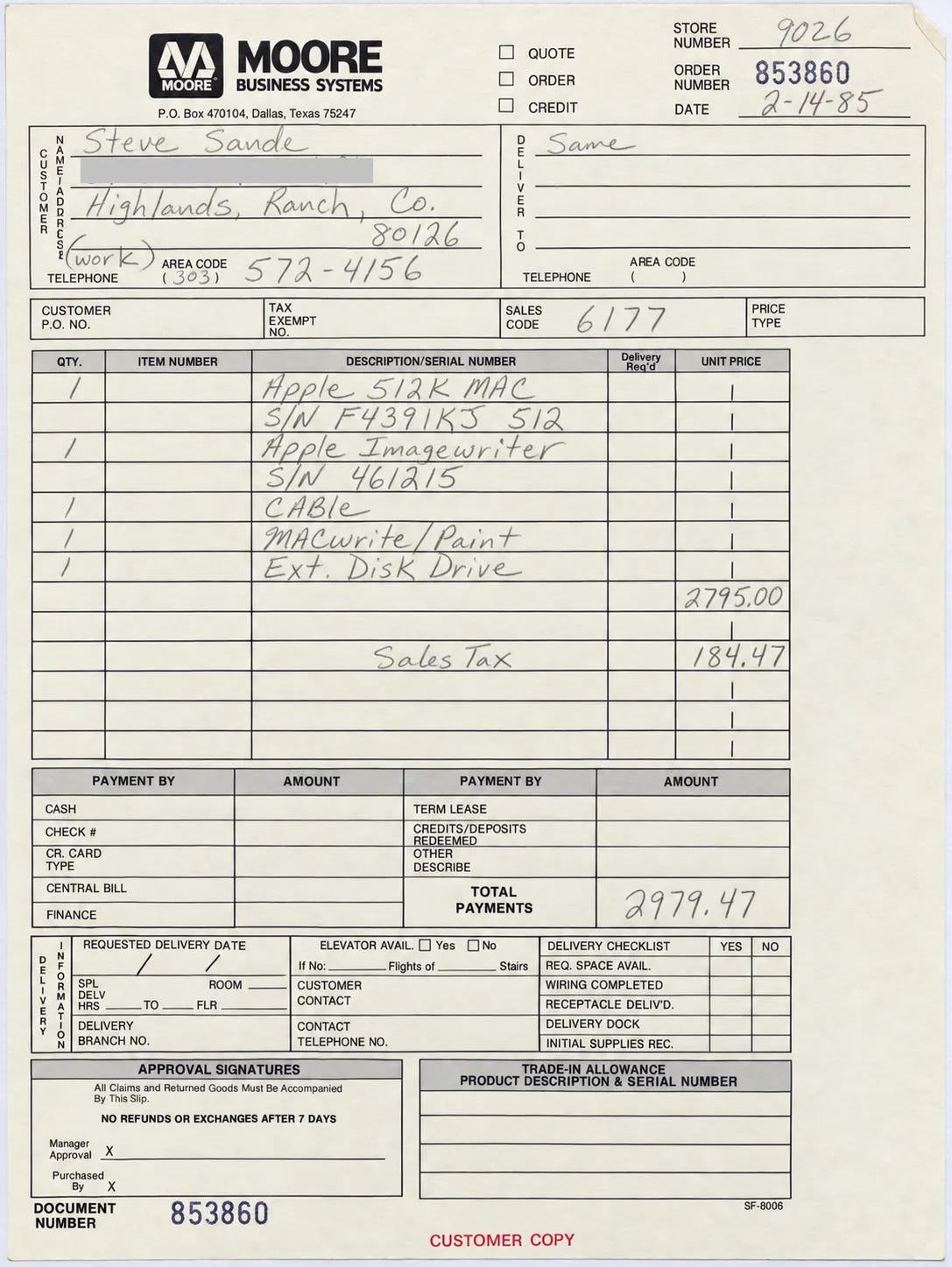
Since it was Valentine’s Day, I didn’t get a chance to take the Mac out of its box until the next evening after work. That Mac stayed with me for quite a while, running my bulletin board system for a while until 1989, when I bought a Mac IIcx. The BBS was getting wildly popular, so at some point I bought another Mac… and I have no idea what it was.
By this point I was making a good salary and also had Apple Developer credentials (which at the time gave me a pretty decent discount on hardware), so whenever I felt the need for a Mac, I bought one. If I didn’t like that Mac or a new model appeared that was interesting, I’d sell the previous one and buy another Mac with that Apple discount. At one point I even owned two of the horrible Mac Portables. Don’t ask me why; one would have been enough.
How The Mac Changed My Life
What I never realized that day in 1984 when I played with my first Mac is that the Macintosh — and Apple — was going to define a lot of my work life from that point onward. I started taking my Mac to work shortly after I bought it, which resulted in many (not all) of the people in my company demanding Macs instead of PCs. I purchased a carrying case for the 512K and its second floppy drive (that made copying software a lot easier…), and lugged that 16.5 lb. beast to work almost every day. That is, until I was able to get approval to start buying them for work, at which time I got a company-owned Mac Plus with a SCSI hard drive.
My work on the “Computer Study” had made me the de facto computer expert, and within a few years I started a new IT department in my company (as you might remember from the Computer Study article, we were a subsidiary of a electric and gas utility company. By the time I was somewhat forced to go to work for IBM in 1995 (that’s a long story), there were about 1,250 Macs in our entire corporation, and almost 275 in our subsidiary alone.
We were the first part of the corporation to use Microsoft Excel, which was released in September of 1985 for Macs only. Windows would get the spreadsheet app later. We did the first desktop publishing, using Aldus (later Adobe) PageMaker to lay out our subsidiary annual report and a regular newsletter. We were the first to use email, and created a statewide store-and-forward email system that used dialup modems to automatically transmit the messages from one office to another. When the Internet arrived, we were the first to use it. Our Macs were also the first computers in the corporation to be networked, first with AppleTalk Personal Network, then with EtherTalk. We had the first file servers, the first laser printers (both monochrome and color), the first scanners. Why were we the first in all of these areas? Because Apple really pushed the technology more than other companies did, and Macs were the initial computers to see many technological advances.
At home, I was starting to do some “development” — primarily with HyperCard. Believe it or not, this simple programming tool was useful for number of rather complex tasks, and I used it to create some applications that we used in our company. One gathered information from a mainframe file, processed it into a readable format, and created a text file that was used for billing. I also wrote a ton of “stacks” for various purposes (HyperCard “programs”) and sold them through a company called Heizer Software; made quite a lot of money that way!
Working for IBM, my first project was to convert as many of the Mac users in the company to the brand new Microsoft Windows 95 as I could. I didn’t want to do it, but it was either that or I was going to be out of a job. So I ran a Windows 95 migration project, taught classes to our Mac users who were going to be switching over, and utterly hated myself for doing that. I still used Macs at home, though, and every chance I had to bring a Mac to work, I did. The one that really impressed my fellow IBM employees was the 12.1-inch aluminum PowerBook that I bought in 2003. It was light, it was tiny, and the programmers in our office loved the fact that underneath the glossy user interface, Unix was the beating heart.
I left that job with IBM in 2004 with two ideas: I would write books about Apple products, and I would become an Apple Consultant Network (ACN) certified member. I started a company called Raven Solutions, LLC and eventually was on the national Advisory Council for the ACN. Through the ACN, I was able to get referrals from the business partners at the new Apple Stores. Neither the ACN or the business partners survive to this day…
In 2008 I started writing online for The Unofficial Apple Weblog (AKA TUAW, later absorbed into Engadget), and would write many millions of words for that website (later part of the AOL group) before it was shut down by new owner Verizon. The day it was closed down, I started AppleWorld.Today, which still exists under new management (I gave the site to my business partner). I wrote a ton of books about Macs and other Apple products for a number of companies over the years, although as you’d expect in the tech business, they were quickly made obsolete.
I had been a fan of products from OWC for many years, and wrote a ton of articles for their Rocket Yard blog. Other work included writing user manuals for software products from a company called Mark/Space — they’re still around, although the applications that I wrote about are no longer needed.
During my many years as a Mac owner and Apple advocate, I attended a number of the Apple Worldwide Developer Conferences, and I’ve lost track of how many Macworld Expo (later Macworld/iWorld) conferences I attended. At many of those events, I was a presenter or a media representative doing interviews. I had the opportunity to talk with two of the founders of Apple — Steve Wozniak and Ron Wayne — as well as many of the top management team members at the company between the late 1980s and the mid-2010s.
Probably the top moment for me was being in the room watching Steve Jobs introduce the iPhone on January 9, 2007. For the first few years of the iPhone phenomenon, I was always in the line at my local Apple Store to get one of the new models. A portion of this video later ended up as part of a documentary on Apple that was actually nominated (didn’t win) for a Best Documentary Academy Award!
My website ties at TUAW and AppleWorld.Today meant I got a lot of free software and accessories over the years, which was quite nice. I also had a tendency to upgrade to the latest and greatest Apple products annually, since I was expected to write about them…
Now that I’m retired, I don’t rush out and buy every new Apple product that shows up. I’m using a 2021 M1 MacBook Pro, a third-generation 11-inch iPad Pro, wear an Apple Watch Series 9, and have an Apple TV 4K that powers the streaming on our 20-year-old Panasonic plasma TV. Other Apple products in the house include my wife’s M1 iMac and a couple of HomePod Minis that we rarely use. Sadly, I can’t use one of my favorite Apple products — AirPods — since I now wear hearing aids. If only Apple made hearing aids for people with moderate to severe hearing loss…
I watched the company grow in the early 80s, taper off through the oddball years of the late 1980s and CEOs like John Sculley, Michael Spindler and the completely horrible Gil Amelio, nearly go out of business in the late 1990s, and then rise to great heights with the return of Steve Jobs and the long tenure of Tim Cook. I can’t say that I am as much of a fan of Apple as I used to be — I prefer playing with offbeat hardware and Linux distros now for “fun” — but I will always have a place in my heart for the company that gave me much of my career.